Prague, Czechia · Advent

Prague Christmas markets with a guide in your ear

Old Town Square, Wenceslas Square, Náměstí Míru and Prague Castle: walk from market to market and let Herodot AI tell you the story of every square, church and stall you pass. Ask it anything, from the tree to the carp sellers.

  • Every market and every street between them
  • Live answers to your questions
  • Works all over Prague and Czechia
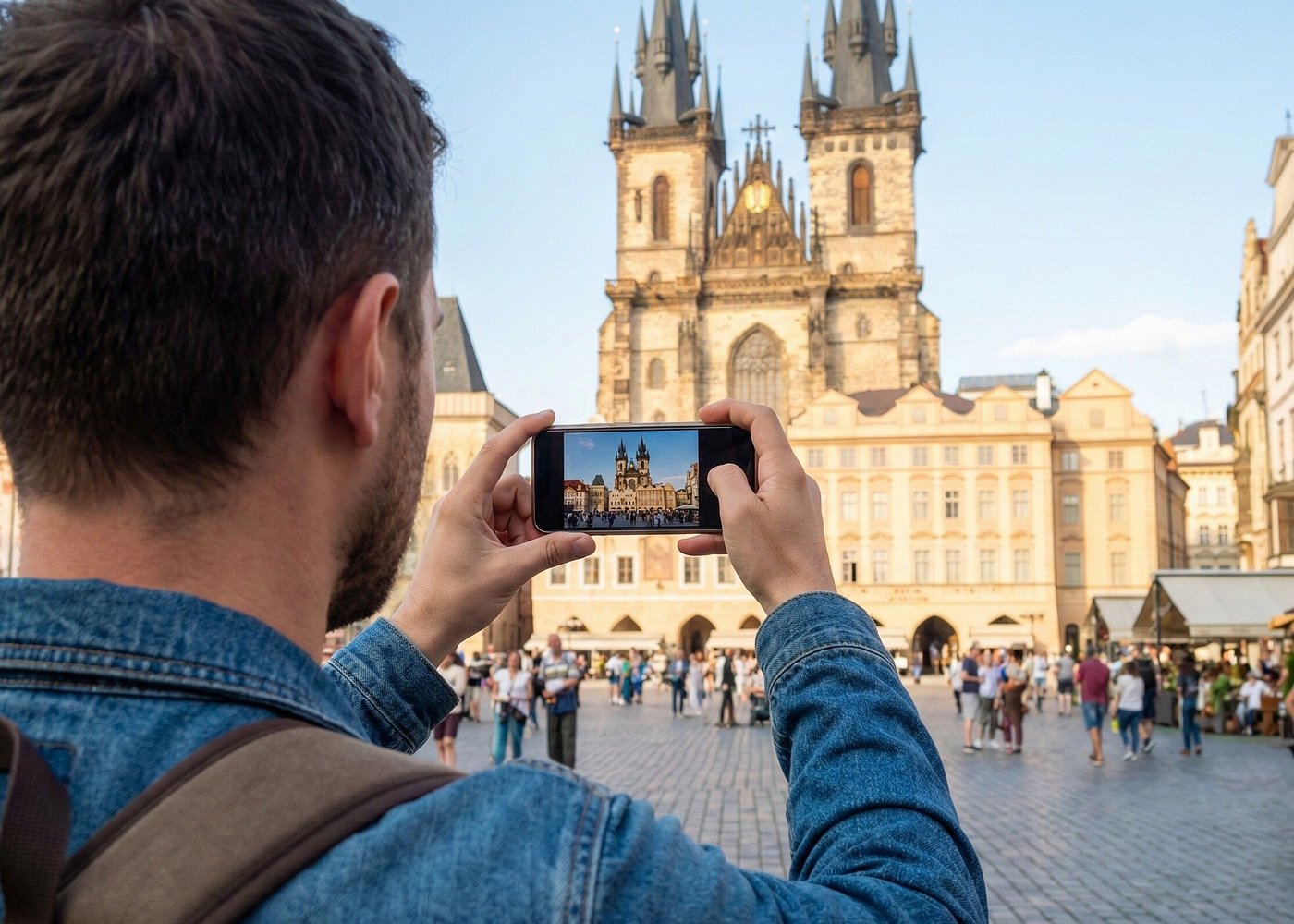
Old Town Square in Prague with the towers of the Týn Church
The main market

Old Town Square (Staroměstské náměstí)

Prague’s largest Christmas market fills the square under the twin spires of the Týn Church. The tree is brought from a Czech forest and lit at the start of Advent; around it stand wooden stalls with mulled wine (svařák), honey mead (medovina), roast ham, Czech glass baubles and wooden toys, and usually a small stable with live sheep and goats that children queue to see.

The square has seen eight centuries of Czech history. Twenty-seven white crosses in the paving by the Old Town Hall mark the Protestant leaders executed here in 1621; the Jan Hus memorial was unveiled in 1915; the Astronomical Clock has shown the hours since 1410. Two minutes from the crowd lie the quiet lanes around Týn Courtyard (Ungelt) and the church of St James.

Astronomical Clock

Every hour the Apostles parade in the two windows while the skeleton rings its bell. The dial shows Central European time, Old Bohemian time counted from sunset, the sun’s place in the zodiac and the phase of the moon. Legend says the clockmaker Hanuš was blinded so he could never build another; the archives tell a different story.

“What does the skeleton on the clock mean?”

Church of Our Lady before Týn

The two towers behind the stalls are not the same: the thicker one is nicknamed Adam, the slimmer Eve. Inside lies the astronomer Tycho Brahe, who died in Prague in 1601 at the court of Emperor Rudolf II.

“Why are the Týn towers different sizes?”

Jan Hus Memorial

The bronze group in the middle of the square was unveiled in 1915, five hundred years after the reformer was burned at the stake in Constance. Under communism people laid flowers here as a silent protest.

Ask it anything here, for example:

  • › Why are there 27 crosses in the pavement?
  • › Is trdelník really a Czech Christmas tradition?
  • › Who was Tycho Brahe?

Get Herodot AI · iPhone and Android

Five minutes away

Wenceslas Square (Václavské náměstí)

Walk down Na Můstku and the Old Town market turns into the second one, in the lower half of Wenceslas Square. It is less a square than a 750-metre boulevard: Charles IV laid it out in 1348 as the horse market of his New Town, and horses were traded here into the 19th century.

The stalls stand where the country’s modern history happened. Crowds gathered under the statue of St Wenceslas when independence was proclaimed in 1918; Soviet tanks drove up the square in 1968; the student Jan Palach set himself on fire by the National Museum in 1969; and in November 1989 hundreds of thousands rang their keys here during the Velvet Revolution. The app tells you which balcony Václav Havel spoke from while you stand under it.

Statue of St Wenceslas

Josef Václav Myslbek’s equestrian statue of the patron saint of Bohemia has stood at the top of the square since 1912. Czechs still say “meet me under the horse”.

“Who was Saint Wenceslas really?”

National Museum

The neo-Renaissance palace closing the square (1891) still shows the patched scars of Soviet gunfire from 1968. Inside is the Pantheon of great Czechs.

Lucerna Palace and the passages

Behind the stalls open the covered arcades of the 1920s and 30s. In Lucerna, built by Havel’s grandfather, David Černý’s horse hangs upside down from the ceiling with St Wenceslas riding its belly.

“Why is the horse hanging upside down?”

Ask it anything here, for example:

  • › Where did Václav Havel speak in 1989?
  • › What happened to Jan Palach?
  • › Why is the square so long?

Get Herodot AI · iPhone and Android

The locals’ market

Náměstí Míru (Peace Square), Vinohrady

Two metro stops from Wenceslas Square on line A, Náměstí Míru is where many Prague families go instead of the Old Town: a smaller market in front of the neo-Gothic church of St Ludmila, more locals than tourists, and usually among the first markets in the city to open.

Vinohrady means “the vineyards”: Charles IV had vines planted on these slopes in the 14th century, and the district that grew here in the late 1800s became Prague’s grandest residential quarter, all Art Nouveau facades and tree-lined streets. The Vinohrady Theatre and the National House stand on the square itself.

Church of St Ludmila

Built in 1888–1892 by Josef Mocker, the architect who completed St Vitus Cathedral; its two 60-metre towers give the square its skyline. St Ludmila was the grandmother of St Wenceslas and the first Czech saint.

“Who was Saint Ludmila?”

Riegrovy sady

Ten minutes’ walk north, the upper lawn of the park has a winter view across the roofs to Prague Castle.

Ask it anything here, for example:

  • › Why is this district called the vineyards?
  • › What is a vánočka?
  • › Which tram takes me back to the Old Town?

Get Herodot AI · iPhone and Android

Above the river

Prague Castle (Pražský hrad)

The castle market stands on St George’s Square, right behind the apse of St Vitus Cathedral and in front of the Romanesque basilica of St George. Take tram 22 up to Pražský hrad, or walk up the Old Castle Steps from Malostranská; there is a security check at the entrances.

Of the four markets this is the one with the most history per square metre: Bohemian rulers have sat here since the 9th century, the crown jewels are kept behind seven locks in the cathedral, and from the ramparts you look down on the lit-up roofs of the Lesser Town.

St Vitus Cathedral

Begun in 1344 under Charles IV and finished only in 1929. Inside: the Chapel of St Wenceslas with walls set with semi-precious stones, the silver tomb of St John of Nepomuk and Alfons Mucha’s stained-glass window.

“Which window is by Mucha?”

St George’s Basilica

The red Baroque front hides the oldest surviving church in the castle, founded around 920; the twin white towers are Romanesque, from the 12th century.

Golden Lane

A row of tiny coloured houses built into the castle wall for the castle guards in the 16th century. Franz Kafka wrote in No. 22 in 1916–17.

“Why is it called Golden Lane?”

Ask it anything here, for example:

  • › Why are the crown jewels locked with seven keys?
  • › Who built the cathedral?
  • › What is the view from the Garden on the Ramparts?

Get Herodot AI · iPhone and Android

Smaller markets and traditions

Between the markets: smaller squares and Czech Christmas customs

Smaller markets also appear on Náměstí Republiky by the Municipal House and the Powder Tower, on Kampa Island under Charles Bridge, on Tylovo náměstí, and in Havelské tržiště, the Old Town’s medieval market street that trades all year. From Old Town Square it is about five minutes on foot to Wenceslas Square, seven along Celetná street to Náměstí Republiky, and half an hour over Charles Bridge and up Nerudova street to the castle.

What you see on the stalls has a story too. Carp are sold live from tubs on the pavements in the days before Christmas, for the Christmas Eve dinner. Vánočka is the braided sweet bread; cukroví are the tiny cookies families bake in a dozen kinds. Presents are brought by Ježíšek, the baby Jesus, on the evening of 24 December, and on 5 December St Nicholas walks the streets with an angel and a devil.

Ask it anything here, for example:

  • › Why do Czechs eat carp on Christmas Eve?
  • › Who brings the presents in Czechia?
  • › What is medovina?
  • › Which is the oldest house on this street?

Get Herodot AI · iPhone and Android

How Herodot AI works on a market walk

Herodot AI is not a fixed-stop audioguide. It is a guide that knows the whole city and answers you.

  • Point your phone at anything

    Snap a photo of the Týn Church, a statue or a house sign and hear its story in seconds, in your language.

  • Ask follow-up questions

    Ask why the skeleton on the clock nods, what trdelník is or where the crowd stood in 1989, and get an answer on the spot.

  • No fixed route, no stop count

    The markets are a loose loop, not a tour. Wander, duck into a side street, come back: the stories are wherever you are, in all of Prague and all of Czechia.

  • Hands in your pockets

    The stories play through your earphones; take the phone out only to ask or to photograph.

One guide for all the Prague Christmas markets

Download Herodot AI, put in your earphones and start at whichever market is nearest. It works in Prague, in Kutná Hora and Český Krumlov, and in every Czech town where no guided tour exists.

Back to top