West Bohemian spa triangle · UNESCO World Heritage

Karlovy Vary, Mariánské Lázně and Františkovy Lázně: the stories, at your pace

A week at the spa is long enough to get to know every colonnade, every spring and every forest path. Herodot AI walks with you, tells the story of whatever is in front of you right now, and answers your questions, as slowly and in as much detail as you like.

  • All three spa towns and the roads between them
  • Ask questions, get answers
  • No list of stops, no clock to watch
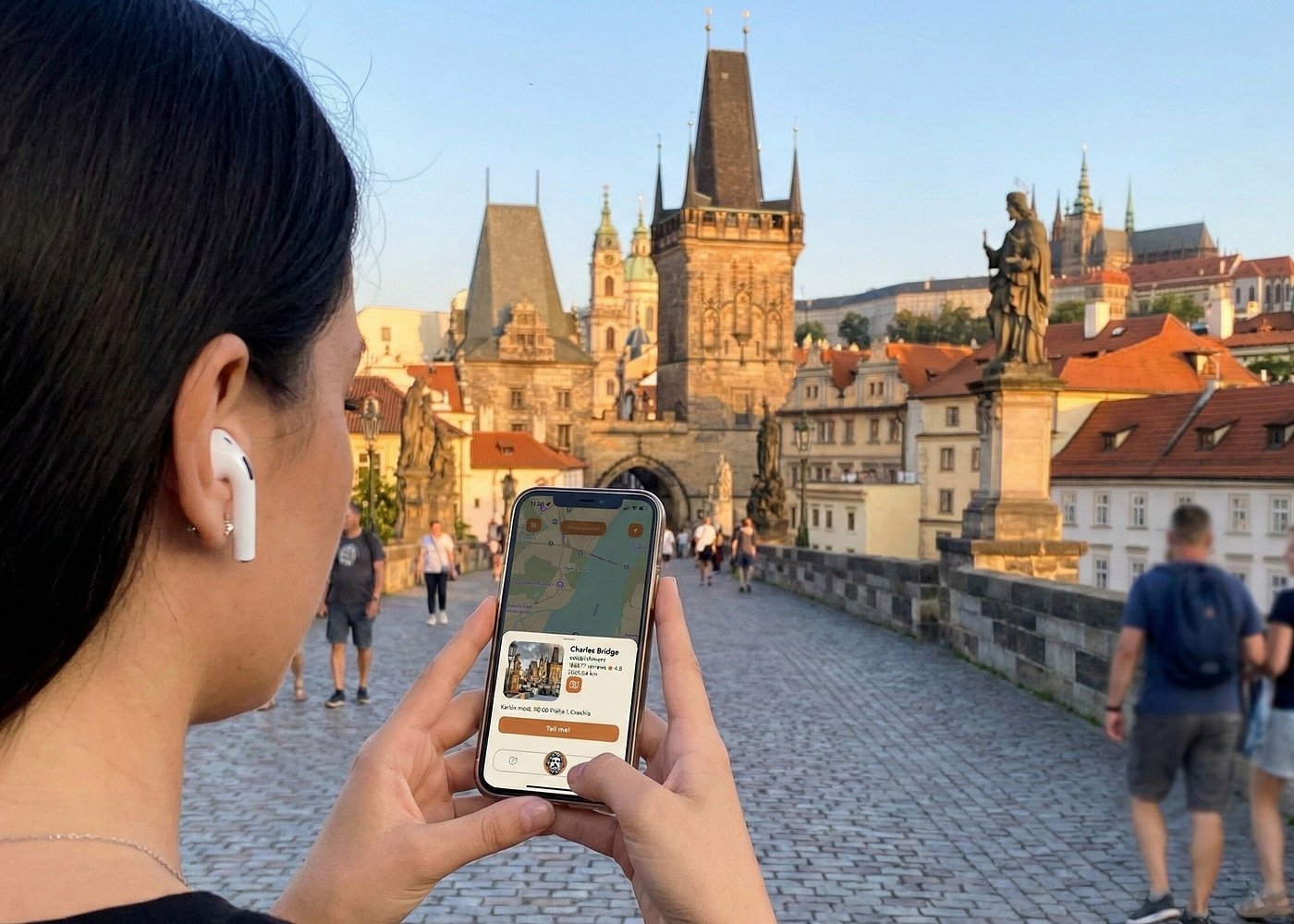
Out and about with Herodot AI: earphones in, the story on your phone
The largest of the three spa towns

Karlovy Vary (Karlsbad)

Charles IV is said to have discovered the hot springs around 1350 while out hunting, when his dog fell into one of them. Ever since, people have drunk from twelve springs here out of porcelain cups with a spout, nibbled Karlsbad spa wafers alongside, and called the herbal liqueur Becherovka the thirteenth spring. The town runs as a narrow ribbon of Art Nouveau and late 19th-century facades along the valley of the Teplá; the colonnades follow the river, and the forests begin directly behind the hotels.

Guests whose names you will read on the houses: Peter the Great (1711 and 1712), Goethe, who came thirteen times, Schiller, Beethoven, Chopin, Gogol, Karl Marx and Sigmund Freud. Ask the app who lived in which house while you are standing in front of it.

The Hot Spring (Vřídlo) and the Hot Spring Colonnade

The hottest spring in Bohemia throws water of around 72 degrees up to twelve metres into the air. In the 1970s colonnade you drink it, cooled, from five basins. The sinter the water deposits once coated roses and small figurines, which were sold as souvenirs.

“Why do you drink from a cup with a spout?”

Mill Colonnade (Mlýnská kolonáda)

The 132-metre neo-Renaissance hall was built between 1871 and 1881 by Josef Zítek, the architect of the National Theatre in Prague: 124 columns, five springs, and on the attic twelve figures for the twelve months.

“Which spring is the oldest?”

Market Colonnade and Castle Colonnade

The white wooden colonnade in Swiss style was built by Fellner and Helmer in 1883 over the Charles IV Spring, the one the emperor’s dog is said to have discovered; a relief inside shows the hunt. Above it stands the Castle Colonnade with its relief of the Spirit of the Springs.

“Is the legend of the hunting dog true?”

Grandhotel Pupp, Becherovka and Moser

From the Saxon Hall of 1701 the Pupp grew into the most famous hotel in the country and served as a location for Casino Royale. The apothecary Josef Becher blended his herbal liqueur in 1807, and to this day only two people are said to know the recipe. Ludwig Moser founded the glassworks in 1857 and supplied courts across Europe.

“What did Goethe do here?”

Walks: Deer Leap and the Diana Tower

From the Market Colonnade a zigzag path climbs in a good twenty minutes to Deer Leap, with the chamois on the rock (1851), and on to Peter’s Height. If you prefer an easier way up, take the funicular behind the Pupp to the Diana lookout tower of 1914 and wander back down on broad forest paths. The riverside promenade along the Teplá from the Hot Spring to the Pupp is flat and made for slow steps.

“Which way up is the gentlest?”

Ask it anything here, for example:

  • › Who lived in this house?
  • › What was this spring good for?
  • › What does the relief above the door mean?

Get Herodot AI · iPhone and Android

The youngest of the three spa towns

Mariánské Lázně (Marienbad)

Before 1800 there was no Marienbad: from 1779 the monastery physician Johann Josef Nehr studied the cold, carbonic springs in the forests of Teplá Abbey, Abbot Karl Kaspar Reitenberger had the spa built, and the gardener Václav Skalník turned the marshy valley into parks. In 1818 the place was declared a spa town; then the world arrived.

The result is a spa town all of a piece: pastel-coloured hotels around a large park, forests full of paths behind them, and the colonnade in the middle. Unlike in Karlovy Vary, the springs here are cold; the app explains why while you stand at the cup.

Cast-iron Colonnade and the Singing Fountain

The 119-metre colonnade of 1889 was cast in Blansko and is the finest iron hall in Bohemia. In front of it, the Singing Fountain has played a piece of music at every odd hour since 1986; in the evening with lights.

“What is the fountain playing right now?”

Cross Spring, Caroline Spring, Rudolph Spring

The Cross Spring under its dome with the golden cross was the first one Dr Nehr examined, and it made the spa’s reputation. The Caroline and Rudolph Springs are a hundred paces further on; each tastes different, and each was good for something different.

“Why do the springs here come up cold?”

Goethe and Ulrike

In the summer of 1823 the 74-year-old Goethe fell in love with 19-year-old Ulrike von Levetzow and had the Grand Duke of Weimar ask for her hand. The refusal became the Marienbad Elegy. The house where he stayed that summer is now the town museum on Goethe Square.

“Where did Goethe stay?”

Edward VII, Chopin, Wagner, Twain, Kafka

The British king came nine times and opened the golf course in 1905; Chopin spent three weeks here with Maria Wodzińska in 1836; Wagner sketched Lohengrin here in 1845; Mark Twain called the place a health factory in 1891; Kafka spent ten days with Felice Bauer at the Hotel Balmoral in 1916.

“What did Mark Twain write about Marienbad?”

Walks: Forest Spring, Geological Park, Hamelika

From the spa park a level path leads to the Forest Spring (Lesní pramen) with its own colonnade; beyond it begins the Geological Park, with labelled rocks along the trail. Another path climbs gently to the Hamelika lookout tower of 1876. There are benches every hundred metres.

“How far is it to the Forest Spring?”

Ask it anything here, for example:

  • › Who was Abbot Reitenberger?
  • › Which hotel is the oldest?
  • › What does the name of this spring mean?

Get Herodot AI · iPhone and Android

The smallest of the three spa towns

Františkovy Lázně (Franzensbad)

Františkovy Lázně was founded in 1793 by decree of Emperor Francis II and built on the drawing board: straight streets, neoclassical houses in imperial yellow and white, parks in between. The cold acidulous springs and the peat made it the spa for women’s ailments, and to this day it is the quietest of the three: everything is on the level and within ten minutes’ walk.

Beethoven took the cure here in late summer 1812, shortly after meeting Goethe in Teplice. Goethe himself came several times and studied the small extinct volcano Komorní hůrka just outside town, where he hoped to settle the dispute over how the Earth was formed.

Francis Spring and little František

The neoclassical round pavilion stands over the oldest and best-known spring. Beside it, since 1923, sits the bronze boy František; legend has it that whoever touches him will have a child within a year, and generations of hands have polished him bright.

“Where does the legend of František come from?”

Spring Colonnade, Gas Colonnade and the spa park

The colonnades and the Imperial Baths lie in a ring of parks; in front of the spa house stands the monument to Emperor Francis from 1853. After the round there is time for a bench in the shade; the app carries on telling stories if you want it to, and falls silent if you don’t.

“Why is everything here yellow?”

Peat and gas baths

Peat from the moors around the town has been used for wraps and baths since the 19th century, and the carbon dioxide rising from the ground for gas baths. If you want to know the story behind the Imperial Baths and the Luisa Baths, ask the app at the door.

“What is a peat bath?”

Walks: Soos and Komorní hůrka

A boardwalk leads through the Soos nature reserve, a moor of bubbling mofettes and white salt crusts a few kilometres outside town; closer still is Komorní hůrka, the small extinct volcano Goethe climbed more than once. Both are flat and can be walked at an easy pace.

“Where does the carbon dioxide come from?”

Ask it anything here, for example:

  • › Who was Emperor Francis?
  • › What was the peat good for?
  • › What did Beethoven do here?

Get Herodot AI · iPhone and Android

For the days in between

Between the spa towns: Loket, Cheb, Teplá Abbey, Bečov

The three spa towns lie barely an hour’s drive apart, and the history of West Bohemia lies between them. Loket is a castle town in a loop of the Ohře, where Goethe celebrated his 74th birthday. Cheb has Špalíček on its market square, the Imperial Palatinate of Frederick Barbarossa and the house in which Wallenstein was murdered. Teplá Abbey, from whose forests Marienbad grew, owns one of the largest monastery libraries in the country. Bečov nad Teplou castle holds the reliquary of St Maurus, the most precious piece of goldsmith’s work in Czechia after the crown jewels.

In none of these places is there an English-language tour waiting for you. Herodot AI is the same guide there as in the spa towns.

Ask it anything here, for example:

  • › How old is Loket Castle?
  • › What is the reliquary of St Maurus?
  • › Why was Wallenstein murdered in Cheb?

Get Herodot AI · iPhone and Android

Taking the cure with Herodot AI

No group to meet, no audio handset on a lanyard, no twenty stops. Herodot AI is a guide who knows the whole region and keeps to your pace.

  • Your pace

    Stop for as long as you like. The story waits, and you can ask a question at any time.

  • Questions instead of stops

    Who is that on the monument, what was the spring good for, why is the lane called that? Ask, and the app answers.

  • A photo is enough

    Take a picture of a facade or a memorial plaque and hear what it is.

  • Everywhere in the spa triangle

    In all three spa towns, in Loket, Cheb and Teplá, and later in Prague too.

One guide for the whole spa week

Download Herodot AI to your iPhone or Android phone and, on your next walk, hear what the colonnade has to tell.

Back to top