Czechia · Road trip

Czechia by car: one guide for every town on the way to Prague

Spa towns, sandstone rocks, castles and beer cities lie along every road into the country, and almost none of them has a guided tour in your language. Herodot AI tells the story of wherever you stop, from the border to Prague, and answers your questions while you walk.

  • Unlimited places: every town, castle and village
  • Ask questions, get live answers
  • Works in Prague at the end too
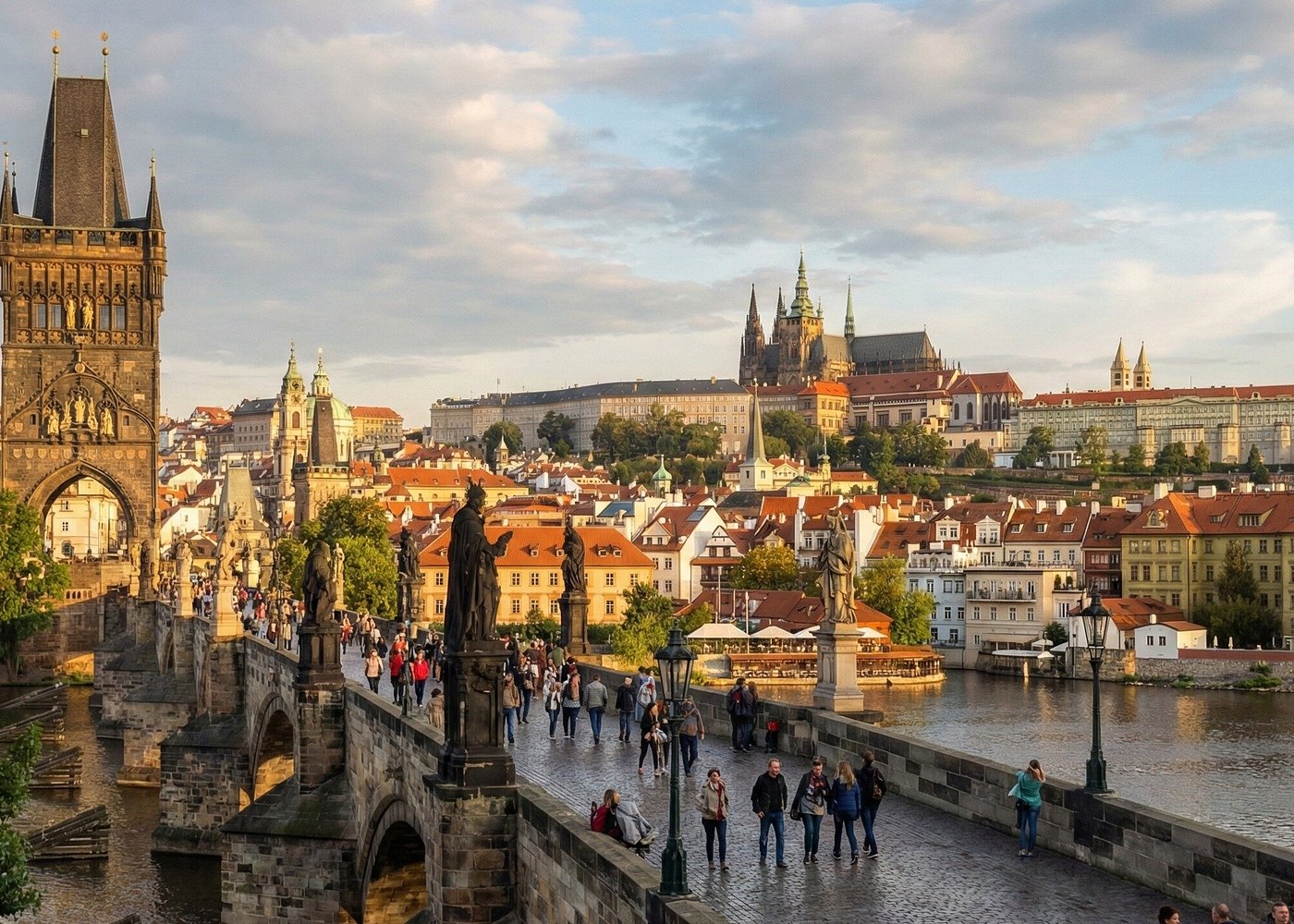
Charles Bridge and Prague Castle, the end of the road
From Bavaria: Nuremberg, Munich, Regensburg

From Bavaria via Cheb, the spa towns and Plzeň

The A6 becomes the Czech D5 at Waidhaus–Rozvadov and reaches Plzeň in half an hour and Prague in about two hours. The A93 crosses at Schirnding–Pomezí straight into Cheb and the West Bohemian spa triangle. Czech motorways need an electronic vignette; buy it online before you cross.

Worth a detour on this corridor: Loket, a castle town in a loop of the Ohře just outside Karlovy Vary; the Baroque monastery of Kladruby near the D5; and Karlštejn Castle, Charles IV’s treasury for the crown jewels, twenty minutes before Prague.

Cheb · Eger

The first town after the border has one of the best-preserved medieval centres in Bohemia. On the market square stands Špalíček, a block of eleven merchant houses with an alley between them barely a metre and a half wide; above the river is the Imperial Palatinate built for Frederick Barbarossa, with a two-storey Romanesque chapel. In 1634 the imperial generalissimo Albrecht von Wallenstein was murdered in a house on the square, now the town museum.

“Why was Wallenstein killed here?”

Františkovy Lázně · Franzensbad

The smallest and quietest of the three spa towns, founded in 1793 and named after Emperor Francis. Yellow-and-white houses line straight streets, the peat and mineral springs were famous for treating women, and legend says touching the statue of the little boy František brings a child within a year. Goethe and Beethoven both took the cure here.

“Why is everything painted yellow?”

Mariánské Lázně · Marienbad

A spa town built in a forest clearing in the early 1800s on the land of Teplá Abbey. The cast-iron colonnade of 1889 and the Singing Fountain are the centre; Goethe fell in love here at 74, Chopin, Wagner and Mark Twain came for the waters, and King Edward VII opened the golf course in 1905 on one of his nine visits.

“Who was Ulrike von Levetzow?”

Karlovy Vary · Karlsbad

The grandest of the spa towns, founded by Charles IV around 1350 after, so the legend goes, his hunting dog fell into a hot spring. The Vřídlo geyser throws 72-degree water twelve metres high; the Mill Colonnade, the wooden Market Colonnade and the Park Colonnade shelter the drinking springs; Grandhotel Pupp, Moser glass, Becherovka and the spa wafers all come from here. Peter the Great, Goethe, Beethoven, Gogol and Karl Marx took the cure.

“Why is Becherovka called the thirteenth spring?”

Plzeň · Pilsen

The city that gave the world pale lager: Pilsner Urquell was first brewed here in 1842 and the brewery cellars can still be visited. Around Republic Square, one of the largest in the country, stand the cathedral of St Bartholomew with the tallest church tower in Czechia, a Renaissance town hall and the Great Synagogue, one of the largest in Europe. US troops under General Patton liberated the city in May 1945, and Plzeň has celebrated it every May since 1990.

“Why is the beer from here golden?”

Ask it anything here, for example:

  • › What is this building?
  • › Is there a castle near the next motorway exit?
  • › Tell me the history of this square while we walk.

Get Herodot AI · iPhone and Android

From Saxony: Dresden, Berlin, Leipzig

From Saxony via Bohemian Switzerland, Děčín and Liberec

The A17 from Dresden becomes the D8 at the border and reaches Prague in about an hour and a half. Leave the motorway for the Elbe valley and you drive into Bohemian Switzerland, the Czech half of the sandstone country you crossed around Bad Schandau.

Also on this corridor: Terezín, the 18th-century fortress that became a wartime ghetto, ten minutes from the D8; Litoměřice with its Baroque square; and Mělník, whose vineyards look down on the meeting of the Vltava and the Elbe.

Hřensko & Pravčická brána · Bohemian Switzerland

Hřensko, the lowest-lying village in Czechia, sits in a gorge where the Kamenice flows into the Elbe. A forest trail climbs from here to Pravčická brána, the largest natural sandstone arch in Europe, 26 metres wide and 16 metres high, with the Falcon’s Nest, a chateau-restaurant the Clary-Aldringen princes built beside it in 1881. Hans Christian Andersen walked here, The Chronicles of Narnia was filmed here, and the forest fire of 2022 left scars you can still see from the path.

“Why can nobody walk across the arch any more?”

Děčín · Tetschen

A chateau on a rock above the Elbe, reached by the Long Ride, a walled road nearly 300 metres long between the gardens. The Thun-Hohenstein family owned it for three centuries; Chopin stayed in 1835 and wrote a waltz for the count’s daughter. Across the river the Shepherd’s Wall cliff carries a small zoo and the best view of the town.

“Which waltz did Chopin write here?”

Liberec · Reichenberg

The “Manchester of Bohemia” grew rich on textiles under the Liebieg family and built itself a town hall (1893) modelled on Vienna’s. Above the city stands Ještěd, the television tower and hotel of 1973 shaped like a cone continuing the mountain, a Czech design icon; the zoo, founded in 1919, is the oldest in the country.

“Who designed the Ještěd tower?”

Ask it anything here, for example:

  • › How did these rocks form?
  • › What happened in Terezín?
  • › Which castle is that on the hill?

Get Herodot AI · iPhone and Android

From Austria: Linz, Salzburg, Vienna

From Austria via Český Krumlov, České Budějovice, Třeboň and Hluboká

From Linz the S10 reaches the border at Wullowitz–Dolní Dvořiště, and the D3 runs north through South Bohemia to Prague. From Vienna you can come the same way, or cross at Mikulov into Moravia (see the eastern corridor below).

Closer to Prague on this road: Tábor, the Hussite town whose streets were laid out as a maze to confuse attackers, and Písek with the oldest surviving stone bridge in the country.

Český Krumlov · Krumau

A UNESCO town folded into a double bend of the Vltava below the second-largest castle complex in Czechia. The Rosenbergs ruled here for three hundred years under the sign of the five-petalled rose; the Schwarzenbergs left a Baroque theatre of 1766 that still has its original stage machinery; and bears have lived in the castle moat since the 16th century. Egon Schiele painted the town in 1911 until the locals drove him out.

“Why are there bears in the moat?”

České Budějovice · Budweis

Founded in 1265 by King Přemysl Otakar II around one of the largest squares in Europe, 133 metres each way, with Samson’s Fountain in the middle and the Black Tower for the view. The original Budweiser, Budvar, has been brewed here since 1895, and the first horse-drawn railway on the continent ran from here to Linz from 1832. Find the wandering stone near the fountain: step on it late at night and, the legend says, you will not find your way home.

“Is this the original Budweiser?”

Třeboň · Wittingau

A walled Renaissance town in a landscape of nearly five hundred fishponds dug in the 16th century by the Rosenberg engineers Štěpánek Netolický and Jakub Krčín. Rožmberk, the largest, covers almost 500 hectares; the autumn carp harvest fills the dykes with onlookers; the Schwarzenberg family tomb stands in a park across the Svět pond; peat baths make it a spa town too.

“How is a fishpond harvested?”

Hluboká Castle · Frauenberg

Between 1840 and 1871 the Schwarzenbergs rebuilt a Gothic castle into a white Tudor-Gothic fantasy modelled on Windsor, with 140 rooms, carved wood panelling and an antler-lined hall. The former riding school houses the Aleš South Bohemian Gallery, and the park runs down to the Vltava.

“Who were the Schwarzenbergs?”

Ask it anything here, for example:

  • › What is the five-petalled rose on every building?
  • › Tell me about the castle theatre.
  • › Where did the horse-drawn railway go?

Get Herodot AI · iPhone and Android

From Poland and the east: Wrocław, Kraków, Katowice, Vienna

From Poland and the east via Olomouc, Kroměříž, Mikulov, Lednice–Valtice and Brno

From Katowice the A1 crosses the border at Gorzyczki–Bohumín and becomes the Czech D1; from Wrocław the road runs through the Kłodzko valley to Náchod. Both lead across Moravia, the eastern half of the country, where the towns are Baroque, the hills are vineyards and the D1 continues to Prague. From Vienna the A5 crosses at Mikulov.

Olomouc · Olmütz

The old capital of Moravia and one of the finest Baroque towns in Central Europe, with few foreign visitors. The Holy Trinity Column (UNESCO), 35 metres of saints, is the largest sculpture group of its kind in the region; six Baroque fountains tell the legend that Julius Caesar founded the city; the astronomical clock on the town hall was rebuilt in 1955 in socialist-realist style, with workers instead of saints. Mozart wrote his sixth symphony here at the age of eleven while hiding from smallpox.

“Why are there workers on the astronomical clock?”

Kroměříž · Kremsier

The summer residence of the bishops of Olomouc, a UNESCO site for its two gardens: the formal Flower Garden of the 1670s with a 244-metre colonnade and a central rotunda, and the landscaped Chateau Garden by the river. The palace gallery holds Titian’s late Flaying of Marsyas; the Vienna court scenes of the film Amadeus were shot in these halls; and the Austrian imperial parliament met here in 1848–49.

“Why did the parliament meet in Kroměříž?”

Mikulov · Nikolsburg

A wine town at the Austrian border under the white cliffs of the Pálava hills, with the Dietrichstein chateau on one rock and the Holy Hill pilgrimage path on another. The Jewish quarter and cemetery were among the most important in Moravia; Rabbi Löw of Golem fame was chief rabbi of Moravia here before he went to Prague. In 1866 the preliminary peace between Prussia and Austria was signed in the chateau.

“What is the giant barrel in the chateau?”

Lednice–Valtice · Eisgrub–Feldsberg

The Liechtenstein princes turned nearly 300 square kilometres between their two chateaux into a designed landscape of avenues, ponds, temples and follies, now a UNESCO site. Lednice is a neo-Gothic fantasy of 1846–58 with a palm house and a 62-metre minaret in the park; Valtice is their Baroque seat and the home of the National Wine Salon.

“Why is there a minaret in Moravia?”

Brno · Brünn

The Moravian capital and the country’s second city. Špilberk fortress above it was the Habsburgs’ harshest prison; the cathedral bells ring noon at eleven, a trick that saved the city from the Swedes in 1645; Gregor Mendel worked out the laws of heredity with peas in the Augustinian abbey garden; Villa Tugendhat by Mies van der Rohe (1930) is a UNESCO monument of modern architecture; a stuffed “dragon” hangs in the Old Town Hall passage; and under the church of St James lies the second-largest ossuary in Europe.

“Why do the bells ring noon at eleven?”

Ask it anything here, for example:

  • › Why is Olomouc not better known?
  • › Where is the best view over Brno?
  • › Which grapes grow around Mikulov?

Get Herodot AI · iPhone and Android

The end of the road

Prague: the same app, the whole city

Leave the car at the edge of the city (park-and-ride car parks sit at the metro termini; the historic centre is a paid zone and much of the Old Town is closed to cars) and take the metro in. In Prague Herodot AI is the same guide: Charles Bridge, the castle, the Astronomical Clock, the Jewish Quarter, and the house sign on the side street nobody else stops at. Ask what you are looking at, and it answers.

Ask it anything here, for example:

  • › What am I looking at?
  • › How do I read the Astronomical Clock?
  • › Which tram goes up to the castle?

Get Herodot AI · iPhone and Android

Why one app for the whole trip

Guided tours exist in Prague. In Cheb, Třeboň or Kroměříž there is usually no tour, no audioguide and no sign in your language. Herodot AI fills that gap in every town on the route.

  • Unlimited places

    No list of stops to buy per town. Every castle, square, church and village along the route is covered, in one app.

  • Stories while you walk

    Stop the car, put in your earphones and hear the story of the square you are standing on, in your language.

  • Ask anything

    Why is the tower crooked, who lived in that house, what is that dish on the menu? Ask, and get an answer on the spot.

  • Photo recognition

    Take a picture of a facade, a statue or a memorial plaque and hear what it is.

Every town on the road to Prague, in one app

Download Herodot AI before you set off. It works in the spa towns, in Bohemian Switzerland, in South Bohemia and Moravia, and in Prague at the end.

Back to top