
Old Town Bridge Tower
The east gate, with Charles IV, his son Wenceslas IV and St Vitus carved on the façade. You can climb it for the view down the bridge to the castle.
Half a kilometre of Gothic stone, thirty statues and six centuries of legends. Stop at any statue you like and Herodot AI tells you who it is, why it stands there and what Prague whispers about it.
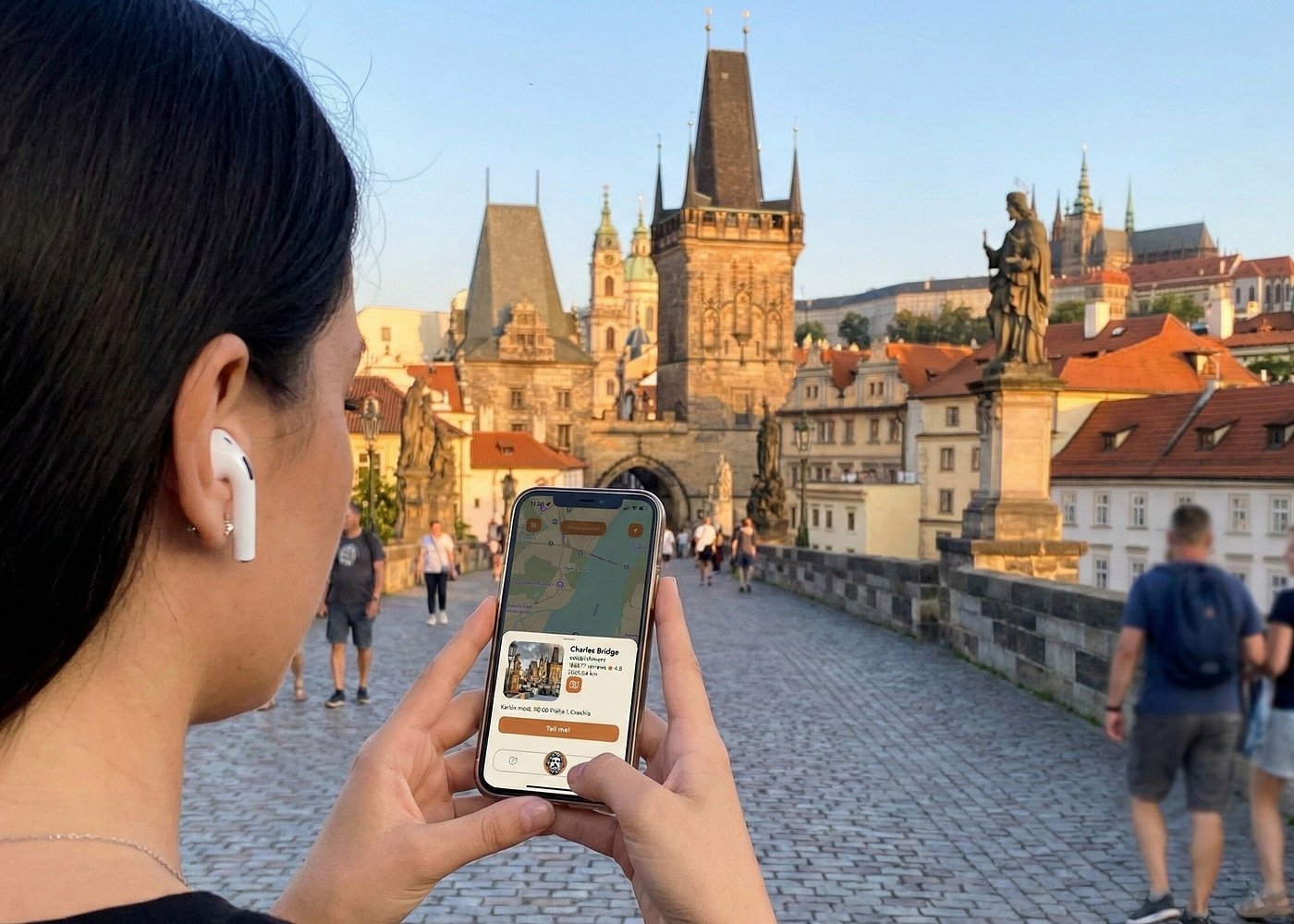
Stop in front of the bronze statue with the five stars and ask “Why does everyone touch this?”. This is the kind of story you hear:
In March 1393, King Wenceslas IV had a quarrel with the Archbishop of Prague, and the archbishop’s vicar, John of Nepomuk, got caught in the middle. He was tortured, tied up and thrown from this bridge into the Vltava. That is the history.
The legend is better. It says the queen confessed to John, and the jealous king demanded to know what she had said. John refused to break the seal of confession, so he went into the river, and five stars appeared on the water where he sank. That is why he wears a halo of five stars. Rub the plaque with the falling priest and you will come back to Prague, they say. The shiny patch on the bronze tells you how many people believe it.
Get Herodot AI · iPhone and Android
Emperor Charles IV laid the foundation stone in 1357, after a flood destroyed the older Judith Bridge. Tradition puts the ceremony on 9 July at 5:31 in the morning, so that the date reads as the palindrome 1-3-5-7-9-7-5-3-1. The builder was Peter Parler, also the architect of St Vitus Cathedral. For centuries it was simply the Stone Bridge, the only crossing of the Vltava in Prague; it was named after Charles only in 1870.
The bridge is about 516 metres long and rests on 16 arches, with a tower at each end: the Old Town Bridge Tower, one of the finest Gothic gates in Europe, and the two Malá Strana towers on the castle side. The thirty statues and groups of saints were added mostly between 1683 and 1714; the originals have since been moved to museums and replaced by copies.
The east gate, with Charles IV, his son Wenceslas IV and St Vitus carved on the façade. You can climb it for the view down the bridge to the castle.
The oldest statue on the bridge, cast in bronze in 1683. People touch the plaques below it for luck; the spot where he was thrown into the river is marked further along the parapet.
Matthias Braun’s group of the blind nun kissing the wounds of Christ is often called the most beautiful sculpture on the bridge.
Below the bridge on the Malá Strana side stands the knight Bruncvík on his column, and steps lead down to Kampa Island and the old water mills.
Ask it anything on the spot, for example:
Get Herodot AI · iPhone and Android


No route, no numbered stops
Herodot AI is not a fixed-stop audioguide. It knows the whole place, so the story is about wherever you are standing, in whatever order you walk.
Ask live questions
Ask about a statue, a date or a legend and get an answer straight away, by voice or by text.
Stories that adapt to you
Say you love architecture, kings or ghost stories, or that you are travelling with children, and it changes how it tells the story.
Any place, not just this one
The same app works all over Prague, all of Czechia and the rest of the world, from the famous sights to the village church no guidebook mentions.
Yes. Herodot AI is an audio guide on your own phone: stop at any statue or tower and it tells you its story, then answers your questions. There is no fixed route, and the same app keeps working when you walk on to the castle or the Old Town.
Before about 8 am, and late in the evening. From mid-morning until sunset the bridge is full of visitors, painters and musicians.
No, the bridge is free and open day and night. Only the climb up the bridge towers needs a ticket.
Download Herodot AI, put in your earphones and start at either tower. It carries on up to Prague Castle, into the Old Town and anywhere else in Czechia.