Giza, Egypt

Pyramids of Giza audio guide that answers your questions

  • Free to try
  • 25+ verified walking routes across Egypt
  • Like a private guide: ask anything, hear it live
  • Every sight, every hidden gem
  • Rated 4.7+ by travellers on both stores

Three kings, forty-five centuries, and the last of the Seven Wonders still standing. Walk the plateau at your own pace and Herodot AI tells you how the pyramids were built, who lies beneath them and what the stones have seen since, and answers whatever you ask.

Hear a story about Pyramids of Giza
The three pyramids of Giza seen from the desert plateau, with Khufu’s Great Pyramid on the right

What Herodot AI tells you at the Pyramids

Stand at the foot of the Great Pyramid and ask “Who built this, and how?”. This is the kind of story you hear:

Put your hand on the block in front of you. It weighs more than a car, and there are more than two million of them above and behind it. Around 2560 BC, gangs of workers dragged blocks like this one up ramps from the quarry just south of here, while finer white limestone came across the river from Tura and granite for the king’s chamber was floated eight hundred kilometres down from Aswan. Herodotus, who visited two thousand years later, was told it took a hundred thousand men twenty years. He was almost certainly wrong about the men.

In 1990 a tourist’s horse stumbled on a wall in the sand just over there, to the south-east. Beneath it archaeologists found the town where the builders lived: bakeries, breweries, barracks and a cemetery of workers buried with bread and beer for the afterlife, some with healed fractures that show they were treated by doctors. These were not slaves. They were paid Egyptians, perhaps twenty thousand at a time, working in teams with names like “Friends of Khufu” painted on the stones. Look up at the rough steps above you: they were once hidden under a smooth casing that gleamed white in the sun, until an earthquake in 1303 shook it loose and Cairo carried it off to build its mosques.

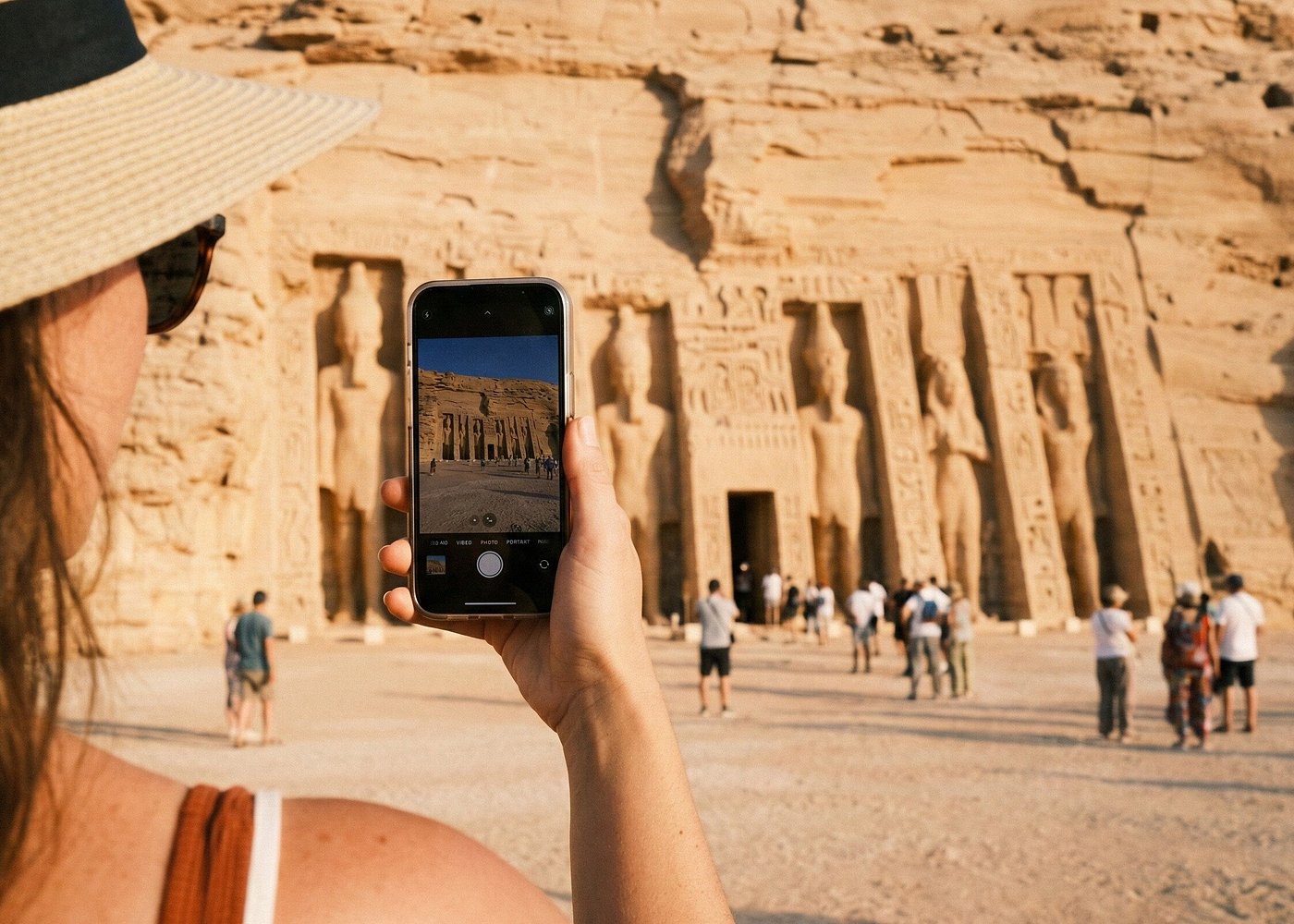
A sample. In the app every story is told on the spot, in your language, and changes with what you ask and what interests you.

Get Herodot AI · iPhone and Android

About the Pyramids of Giza

The pyramids stand on a limestone plateau on the western edge of Cairo, where three kings of the Fourth Dynasty built their tombs in the 26th century BC. Khufu came first: his Great Pyramid rose to 146.6 metres, held the record as the tallest structure on Earth for nearly four thousand years and is the only one of the Seven Wonders of the Ancient World still standing. His son Khafre built the second pyramid, and Khafre’s son Menkaure the third and smallest.

The plateau is a whole royal cemetery, not three monuments. Small pyramids for queens stand beside Khufu’s and Menkaure’s, nobles were buried in rows of flat-topped mastabas, causeways ran down to valley temples by the Nile, and the Great Sphinx guards Khafre’s approach. In 1954 a sealed pit beside the Great Pyramid gave up a 43-metre cedar boat built for Khufu; it is now displayed in the Grand Egyptian Museum next to the plateau. The site has been a UNESCO World Heritage Site since 1979.

Built
about 2600 to 2500 BC, for Khufu, Khafre and Menkaure
Today
Open archaeological site and UNESCO World Heritage Site, part of the Memphis necropolis
Getting there
Taxi or ride-hailing from central Cairo (about 45 minutes), or metro line 2 to Giza and a taxi for the last stretch
Time to allow
3 to 4 hours for the three pyramids, the viewpoint and the Sphinx

What to see at the Pyramids of Giza

Great Pyramid of Khufu

About 2.3 million blocks, 230 metres along each side and still 138 metres high after losing its tip and its polished casing. You can climb inside through the tunnel medieval treasure hunters cut and up the Grand Gallery to the King’s Chamber.

Pyramid of Khafre

Slightly smaller than Khufu’s but set on higher ground, so it often looks taller. Near the summit it still wears a cap of the smooth Tura limestone that once covered all three pyramids.

Pyramid of Menkaure

The smallest of the three, about 65 metres high, with granite casing on its lowest courses. The deep gash in its north face is the mark of a 12th-century attempt to pull it down, abandoned after eight months.

Queens’ pyramids

Three small pyramids east of Khufu’s and three south of Menkaure’s, built for royal wives and mothers. Khufu’s mother Hetepheres had her own tomb nearby, found intact in 1925.

The panoramic viewpoint

A rise in the desert south-west of Menkaure’s pyramid where all nine pyramids line up in one view, with Cairo behind them. The classic photograph is taken here.

Ask it anything on the spot, for example:

  • ›How did they lift the stones to the top?
  • ›What is inside the Great Pyramid?
  • ›Why does Khafre’s pyramid look taller than Khufu’s?
  • ›Where is the Solar Boat now?

Get Herodot AI · iPhone and Android

How Herodot AI works

  • No route, no numbered stops

    Herodot AI is not a fixed-stop audioguide. It knows the whole place, so the story is about wherever you are standing, in whatever order you walk.

  • Ask live questions

    Ask about a statue, a date or a legend and get an answer straight away, by voice or by text.

  • Stories that adapt to you

    Say you love architecture, kings or ghost stories, or that you are travelling with children, and it changes how it tells the story.

  • Any place, not just this one

    The same app works all over Prague, all of Czechia and the rest of the world, from the famous sights to the village church no guidebook mentions.

Before you go

Is there an audio guide for the Pyramids of Giza? +

Yes. With Herodot AI the audio guide is on your own phone: start it anywhere on the plateau and it tells you the story of what you are looking at, then answers your questions. It is not a fixed list of stops, so you can wander in any order and also use it in the rest of Egypt.

Do I need a ticket for the Pyramids of Giza? +

Yes. A general ticket to the plateau covers the outside of the pyramids, the viewpoint and the Sphinx; going inside the Great Pyramid or the pyramids of Khafre and Menkaure needs a separate ticket, bought on site or online. Herodot AI is a story guide and does not include entry tickets.

How long does a visit take? +

Three hours covers the three pyramids, the viewpoint and the Sphinx on foot; allow half a day if you go inside the Great Pyramid, and a full day if you add the Grand Egyptian Museum next door.

Your own guide to the Pyramids of Giza

Download Herodot AI, put in your earphones and start at the plateau gate. The same app goes with you to the Sphinx, into the rest of Cairo and on to anywhere in Egypt.

Back to top